Âmago helps hotels save energy
An article from the weekly barlavento, 19 October 2017: how Âmago came to energy performance contracts, which save hotels thousands of euros a year.
A company founded in 2008 has been growing in efficient energy-saving solutions — systems that let hotel owners save thousands of euros every year.
Energy efficiency is a phrase that has begun to feature in the accounts of anyone who wants to save a lot of money at the end of the month. Âmago, based in Portimão, helps find solutions, installing systems or measures with that aim. Its main focus is large buildings, particularly hotels, and that is where the company, run by João Raposo, is making its mark.
“We are very focused on non-residential buildings — hotels, shopping centres, schools, hospitals — and not so much on housing, although we also do energy certification for private clients. Our great speciality is large buildings,” João Raposo, director and founder of Âmago, told barlavento.
A member of the first year of what was then called Thermal Engineering at the Polytechnic Institute of Faro, he leads a team of seven technicians, engineers and an architect, who found a new way to grow by focusing above all on the needs of the hotel industry.
The business began in 2008, at the time very much centred on the new energy certification. The crisis that hit construction from that year on led Âmago to diversify its core business.
Every time the team issued an energy certificate, backed by a detailed report with measures to make the building more efficient, João Raposo noticed that clients kept the paper — which, in some cases, was just a formality needed for a deed or a loan. In practice, they did little or nothing to put the recommendations into effect. “Basically, we weren’t implementing energy efficiency, nor achieving savings,” he said.
João Raposo then decided to bet on a business model for larger buildings which, though new in Portugal at the time, was no longer new in the United States or the rest of Europe.
“We would present a report, the result of an energy audit, estimating that an investment of around 300,000 euros would lead to savings of 100,000 euros a year. It would pay for itself in three years,” he explained.
The problem, made worse by the crisis, is that clients often doubted whether the investment they would have to make would actually translate into the payback and savings the company presented. “We are so confident that these estimates are right that I am willing to find the money and carry out the works. The client pays according to the savings that result,” the founder of Âmago said. This is what is called an energy performance contract.
Of those 100,000 euros, the client receives 10% up front, and starts saving without spending anything.
“We bill 90% and, instead of three years, it will be a period of four, five or seven, which lets us make a return on the investment, allowing for our margin and for the fact that we have to pay interest on the financing,” he revealed. In other words, the client takes no risk, gets an energy-efficient building delivered by a specialist team, and has guaranteed results.
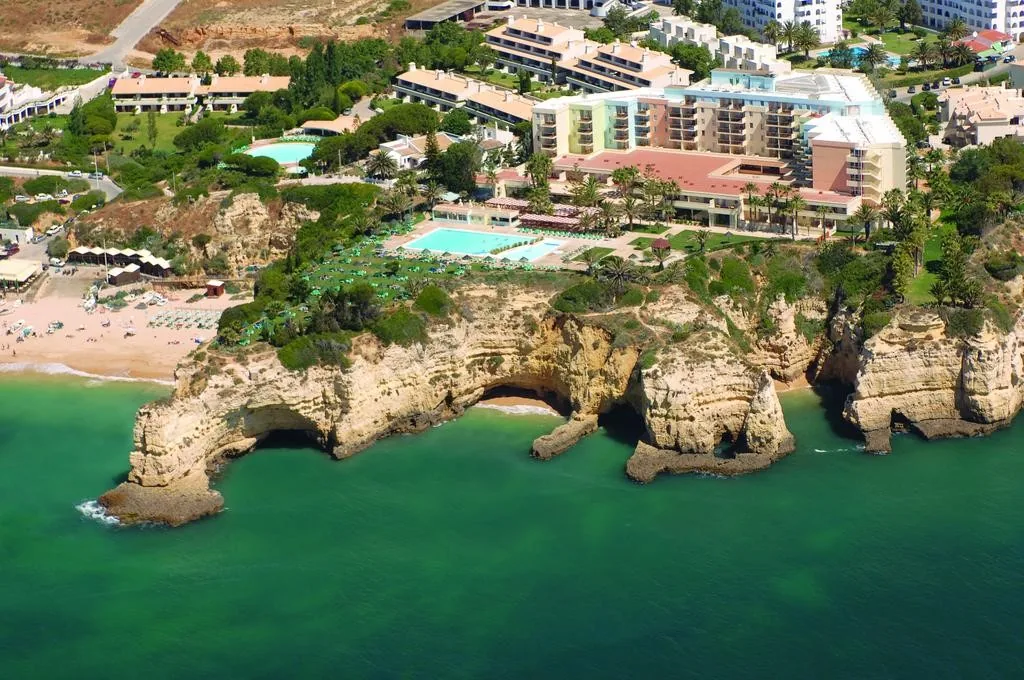
Âmago’s first energy performance contract was at the Pestana Dom João II Beach Resort in Alvor which, billed since 2014, achieves savings of around 25%. It was the first contract in the Algarve and the second in the whole country.
The hotel group has also invested in an energy performance contract at the Pestana Viking Beach & Spa Resort in Armação de Pêra, where the company is achieving energy reductions of around 40 to 45%.
The third contract was signed with the Pestana Alvor Park, the first site where photovoltaic panels were also installed, and more contracts are planned. It was with its first energy performance contract that the company entered the Innovation Support Fund (FAI) competition, and won. “We showed that we could achieve the greatest savings, and so we earned the right to be lent the money: 70% of what we needed. In other words, of 388,000 euros, we received 270,000. The approval gave us a year’s grace and three years to repay the loan, interest-free,” he said.
The focus on hotels is interesting, as it is an industry exposed to many challenges, such as seasonality. “They can’t switch everything off and keep the hotel running. Some hotels use a lot of energy for heating in the winter months, because they have to keep the common areas warm even at ten or fifteen per cent occupancy. And it costs the same whether revenue is high or low.”
Unlike in the recent past, installing efficient heating, ventilation and air conditioning (HVAC) systems is now a specialist branch of engineering, since the thermal comfort of buildings is decisive for saving energy. This is another area Âmago has been developing.
“In designs for new buildings we try to reduce consumption through the choice of materials, working with the architects — with the windows and the thermal insulation, for example. Once we have optimised the building thermally, we add what is needed for heating, cooling or ventilation,” making use of renewable energy wherever possible, he added. “The legal minimum energy rating for a new building is B-. But we always try to make it as high as possible, as long as the architect and the owner are willing.”
Monitoring is essential
When it implements energy performance contracts, Âmago has to guarantee that the savings are real, so monitoring the energy efficiency measures and systems is essential. “We analyse consumption daily or, sometimes, hour by hour — so that there are no anomalies. If there is a water leak or abnormal consumption, we are alerted by email and text message. Whenever a value strays too far from normal, the system warns us,” he explained.
João Raposo can see on a computer, in real time, how the system is working at a given site. Taking the Pestana Viking in Armação de Pêra and the Pestana Dom João II in Alvor as examples, he showed barlavento, at the office in Portimão, that one click is enough to switch on the air conditioning in a room. That is the building management system.
“Large hotels usually have a central cooling system. The water leaves at seven degrees and comes back at twelve, for example. The reason for the high savings we are achieving at the Viking is that these temperatures vary. When air conditioners cool the inside, they throw heat out. But we can use that heat — to produce domestic hot water, for example,” he explained.
The hotel has four tanks of five thousand litres of water each, and can heat it almost for free. “In summer, the diesel boilers are off. They used to run 12 hours a day; now they are on for twenty minutes. It’s a huge cost reduction,” he said.
This energy management went through a long period of fine-tuning and assessing the hotel’s needs, and it is the kind of work that not all companies “in our field know how to do or feel confident enough” to take on.
Changing some habits was also essential to reach the desired efficiency, without affecting the quality of service to guests. “In buildings there are hours when energy is more expensive — typically from 9 a.m. to 12.30 p.m. The pool pumps, for instance, have to run all day in summer, but in winter they can be switched off during those hours. One day someone started using energy on one of the meters; the system alerted us and we went to see what was going on. It was the divers, using the machine to fill their diving tanks. We explained that, if it was no trouble, they should do it in the afternoon, because of the energy costs.”
Âmago created the GEMAX software for hotel maintenance
A hotel usually has dozens or hundreds of rooms, many different spaces and a great deal of equipment that needs maintenance to avoid unnecessary costs. GEMAX, created by Âmago, meets the sector’s need for a building maintenance plan and an incident log.
“To obtain an energy certificate you must have a corrective and preventive maintenance plan, as well as an incident log, which must hold the full history of work on the air conditioning equipment, as the law requires. It can be a sheet of paper or a Word document, but few people do it,” he summed up. In 2010 he looked at the maintenance software on the market and concluded that it had been designed for factories or large merchant navy ships, and was very complicated and heavy.
He got down to work and developed a simple, versatile concept with Tiago Pinto, an engineer at Âmago, and a team of programmers.
The result was a program installed in all of the Pestana group’s Pousadas de Portugal in 2012 and extended to the group’s other hotels on the mainland and the islands in May 2016: around 65 sites, a big step for the Portimão company.
“That is another pillar that tackles one aspect of energy efficiency: preventive maintenance of the equipment. If filters are cleaned regularly and belts and lubrication are monitored, machines run better, use less energy and break down less,” João Raposo argued.
At any time, a hotel’s maintenance technicians “can know what work was done on that machine, in that room or on the boiler”, and when. In practice, anyone working in the hotel can raise a work request or report a fault. A text message or notification is sent to the technician, who manages the tasks according to urgency. “Someone enters in the program that the air conditioning in room 203 isn’t working. The maintenance technician fixes it and, at the end, records in the system what he did. He manages the daily tasks, and the spaces build up a history of work, which makes it possible to spot a recurring problem,” he explained.
The program is in use and under continuous development, and is being prepared for mobile apps.
A Portimão company competing with the energy giants
“We are the only company in the Algarve entirely dedicated to energy efficiency. We could do other kinds of engineering projects, but we don’t want to. At the moment we provide three distinct services. There are more companies in the country, but in energy services of this kind there are only 41 companies registered with the Directorate-General for Energy,” he said. They compete side by side with big names such as EDP and Galp. “We are small and very competitive, we achieve greater savings than the others, and we reach the savings we commit to. That’s our big difference,” the founder said.
An Algarve company reaching beyond the border
The Pestana group is the Portimão company’s client with the most buildings using its energy efficiency services. But over its nine years Âmago has won many other projects. In the city where it is based, the team worked on the refurbishment of the Mabor building, near the riverfront, for which it carried out the thermal design in partnership with a civil engineering and architecture firm. There, the existing building had to be adapted to implement the energy efficiency measures. “Almost everything was done, from replacing the glazing to installing solar systems,” João Raposo revealed.
In the same municipality, the company carried out the energy certification of the Pestana Race Hotel, next to the Algarve International Circuit, as well as “some work with the Hotel Júpiter chain, which has hotels in Lisbon and Portimão”. Elsewhere in the country — Lisbon, Viseu, Bragança, Madeira — and in São Tomé and Príncipe, it has energy efficiency measures in hotel groups, office buildings, private schools, supermarkets and hypermarkets. “Other chains are not yet very aware of this issue, because they work on tighter margins,” he explained. Public bodies, such as town councils, come up against legal restrictions that make it hard to use energy performance contracts. Projects in southern Spain are on the horizon.
Investing to save at home
Most energy-saving tips for the home are already well known, but it never hurts to repeat some of them. João Raposo said that the contracts the company develops are better suited to hotels, services and large buildings than to private homes. “We achieve five-year energy performance contracts, because any longer makes the interest heavier. At home it is hard to get similar terms, because it depends a lot on how people use their equipment and, since the amounts of energy are very small, it isn’t worthwhile for us as a company.”
Although it is not a measure for private clients, he encourages people to invest in energy efficiency out of their own pocket, because “over five or six years it will pay off”. “At home, solar thermal or even photovoltaics, if conditions allow, pay off, even at just 1,500 watts. Self-consumption has to be handled very carefully, because as a rule we’re not at home during the day,” he warned. In other words, first look at the consumption of the equipment that is always on (the fridge, the freezer). “Sometimes 200 or 300 watts, which is one or two panels, is enough to balance it. More can be a waste, because you then can’t sell the energy or, if you can, it is at very low rates of four or five cents.” In a larger home, with pool pumps and irrigation, a larger investment in photovoltaics pays off.
Other examples: LED bulbs in the rooms where the light is on longest (the kitchen, the living room), flow restrictors on taps, and replacing appliances more than ten years old. “I did the maths at home and found that if I replaced the fridge I would save a hundred euros a year. A new one costing 700 euros pays for itself in seven years and, if looked after, lasts a long time. In my view, it already pays to replace a ten-year-old fridge,” he concluded.
Energy certification has only been in place for eight years
The turning point came in 2006, when the energy certification legislation was created, though it only began to be applied to buildings three years later. In August 2013 the legislation was revised, and the new rules came into force in January of the following year. The subject now has a decree-law revised four times, almost ten ministerial orders, twelve orders and four or five corrections, João Raposo explained.
And when the subject is saving on energy costs, it turns to state aid, incentives and grants. “There is the Operational Programme for Sustainability and Resource Use Efficiency (POSEUR)”, with European funds that companies, the state and private social solidarity institutions can apply for — a measure that was delayed because “the European Union felt the need to correct some aspects of the energy legislation that did not match the spirit of the European directive”.
Article published in the regional weekly barlavento on 19 October 2017.
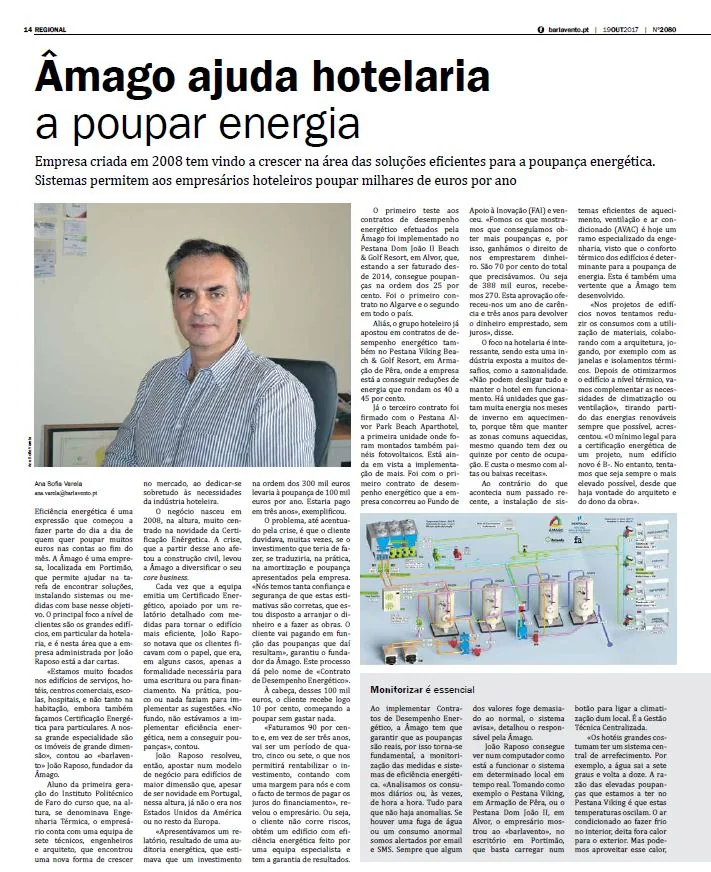
The article in barlavento, page 14.
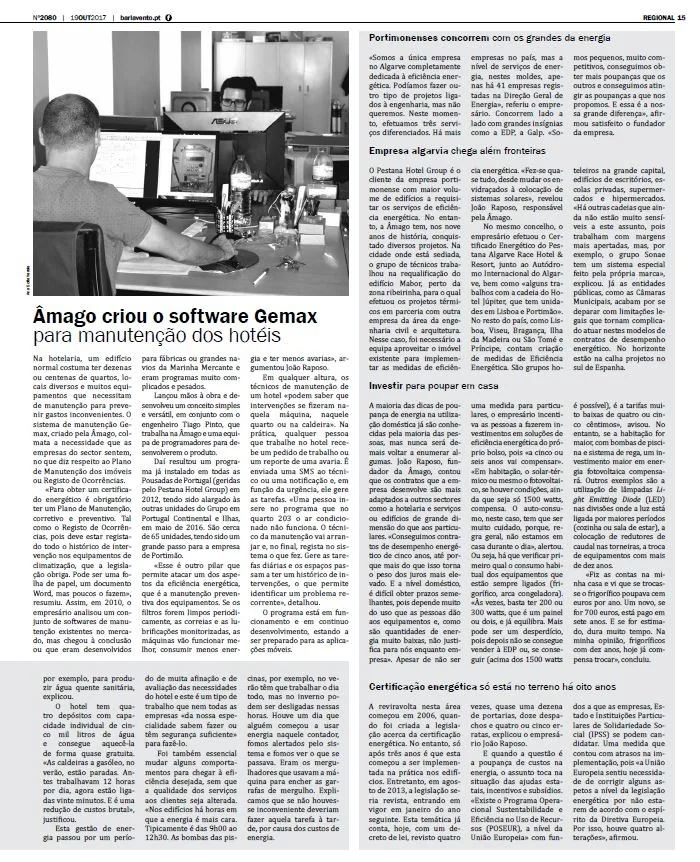
Page 15.